evaltrack examples
Small, runnable evals that double as documentation. Each file is a self-contained pytest module that
uses the @pytest.mark.evaltrack marker. The marker records the run (to ./.evaltrack by default).
Examples 1 to 6 are async def tests marked with @pytest.mark.asyncio, so they need
pytest-asyncio. The command below installs it
for one run. Examples 7 to 10 are sync and need no async plugin.
Your own evals can use any async plugin.
anyio uses @pytest.mark.anyio instead.
On pydantic-ai. The agent examples (4 to 6) use pydantic-ai, but evaltrack does not require it. A pydantic-ai
FunctionModelstands in for a real model. Examples 1 to 6 record pydantic-evals runs, and pydantic-evals evaluates any callable, a plain function (examples 1 to 3) or an agent or LLM call from any framework. Examples 7 to 10 use no pydantic-evals at all.
No LLM calls, no API keys
Every example runs offline, so CI runs them all. Examples 1 to 3 and 7 evaluate plain Python. Deterministic code does not normally need an eval, but these examples show the mechanics with nothing to configure. Examples 4 to 6 evaluate pydantic-ai agents, and 8 to 10 DeepEval test cases, whose model replies and judges are scripted, so they run without a key too. The next section says how to run them against a real model.
| File | Shows |
|---|---|
test_01_function.py |
The basics: a function under test, a custom assertion evaluator, and the marker's gate and recording. |
test_02_scores.py |
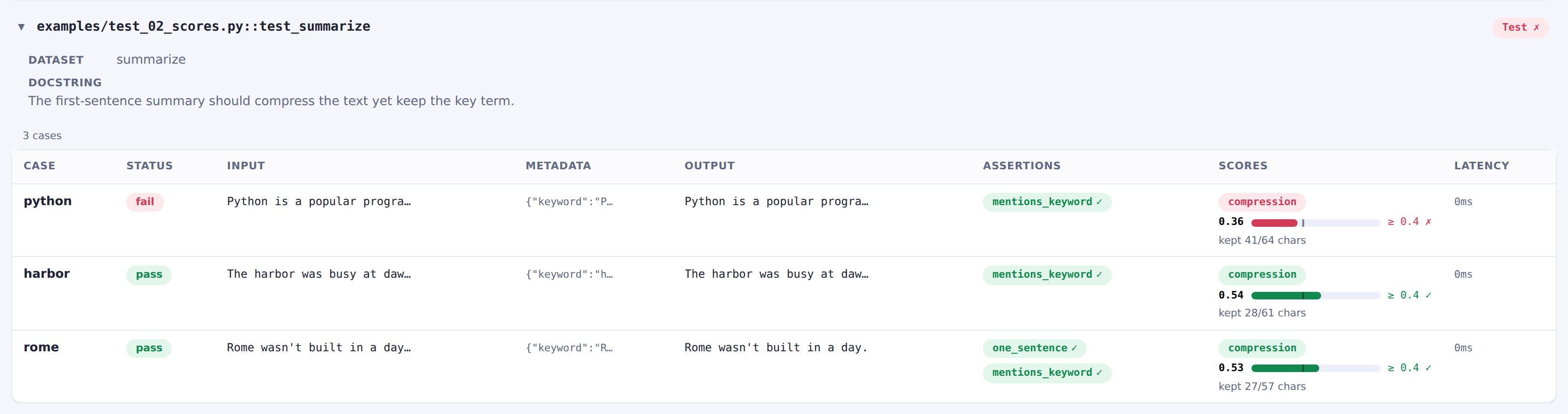
Numeric scores + per-case score_bars, dataset- vs per-case evaluators, and reading Case.metadata. |
test_03_reliability.py |
Absorbing a flaky failure with flake_reruns, plus reliability_target and eval_version for cross-run tracking. The flakiness is faked, so a rerun always happens. |
test_04_agent_tool_use.py |
Evaluating tool use: the agent calls a tool only when the query needs it (ToolCalled / NoToolCalled, per-case). |
test_05_llm_judge.py |
LLMJudge grading the output as a binary assertion (a guardrail) and a graded score (gated by score_bars), plus a cheap deterministic check. One case misses the bar on purpose. |
test_06_fake_tool_in_inputs.py |
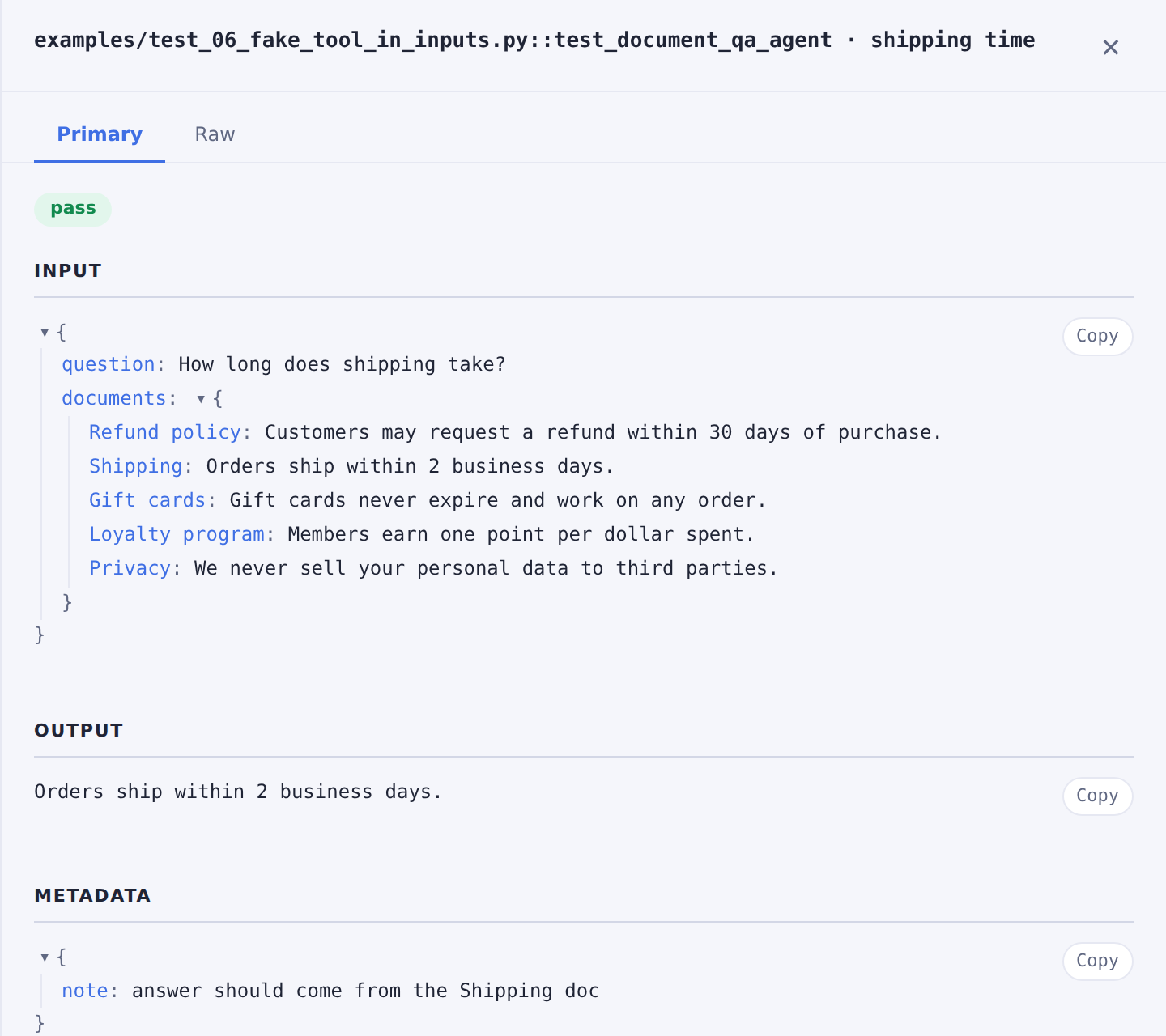
Making a faked tool's data visible in the run by seeding it from Case.inputs instead of a fixture, so the dashboard shows what the agent could retrieve. |
test_07_other_eval_runner.py |
Recording a made-up eval runner: a translator plus evaltrack.run(). Not an async test, so it needs no async plugin. |
test_08_deepeval.py |
A DeepEval evaluate() recorded and gated: a GEval judge's threshold and verdict as the case's bar, a metric with no threshold gated by score_bars. |
test_09_deepeval_repeats.py |
The marker's repeats=N over a runner with no repeat of its own: evaltrack calls evaluate() N times and demands every attempt passes. One case fails a round, so the test fails. |
test_10_deepeval_traced.py |
Scoring the parts of a traced app: @observe metrics, driving dataset.evals_iterator(), and naming every scored span so two cases never share an id. |
Evaluating agents
Examples 4 to 6 evaluate pydantic-ai agents, their tool use and their output quality. The agent, its
tools, the dataset and the evaluators are what you write for a real model. Only the model is a
stand-in, a pydantic-ai FunctionModel with replies scripted in
the example file. In example 5, the judge is one too. This stand-in makes the examples deterministic
and runnable in CI. It is also what you lose. The model never surprises you.
To run one against a real model, pass a model string such as "openai:gpt-4o-mini" to Agent(...).
In example 5, pass it to LLMJudge(model=...) too. Then remove the ALLOW_MODEL_REQUESTS = False
line. Set the provider's key:
uv sync                  # dev deps include pydantic-ai-slim[openai]
export OPENAI_API_KEY=sk-...
Making a faked tool's setup visible (test_06)
test_06_fake_tool_in_inputs.py
seeds a faked document store from Case.inputs rather than from a fixture, so the run records what
the agent could retrieve. Its docstring says why. This is what that looks like in the dashboard:
Run them
--with installs the async plugin for that one command. To run a single example, replace
examples/ with its file path.
uv run --with pytest-asyncio pytest examples/
uv run evaltrack ui   # open the dashboard on the recorded runs
In the dashboard
After you run some examples, evaltrack ui shows each run with its per-case verdicts, scores, and
the test docstring as context.
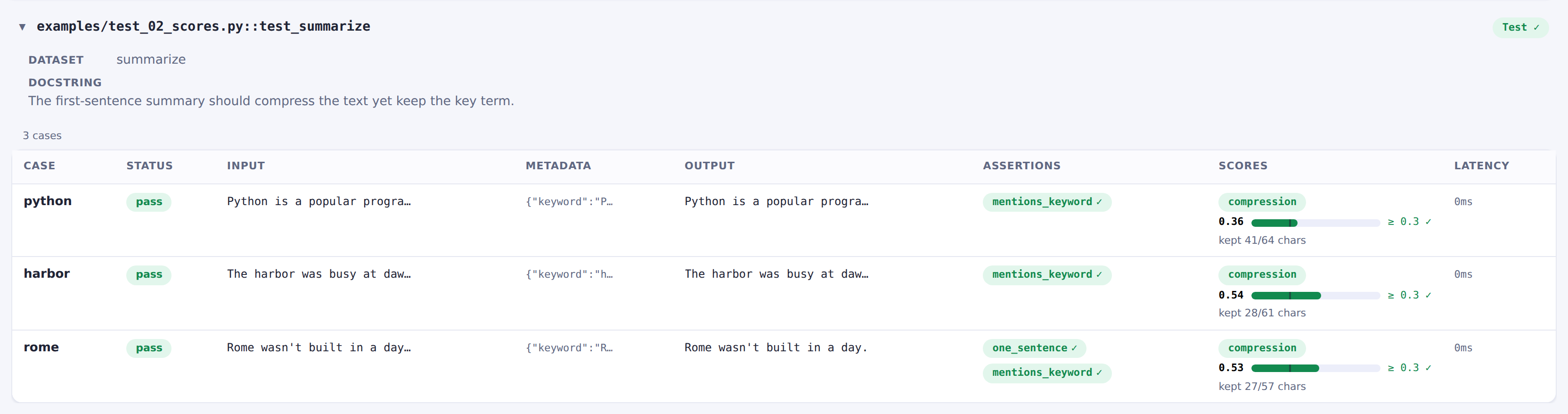
Every example is deterministic. Examples 5, 7 and 9 each fail on purpose (5 misses a score bar, 7
misses a runner's bar, 9 answers one of its rounds wrong), and all three have an xfail mark, so
the suite stays green. To see a failure in the others, raise a score_bars bar or change a case's
expected value.